Time in the market: the importance of staying invested
Far more money has been lost by investors preparing for corrections or trying to anticipate corrections than has been lost in the corrections themselves.
Peter Lynch, Investor and author
Few investors would turn down an investment opportunity that compounds wealth at an exceptional rate of return over time. During Peter Lynch’s tenure managing the Fidelity Magellan Fund from 1977 to 1990, the Fund generated an annualized return of approximately 29% per year. Despite Lynch’s stellar track record, the average investor in his fund earned a return closer to 7%.1
The difference is sometimes referred to as the behaviour gap and results from investors buy and sell decisions. When the average investor return falls short of the manager return, it means investors have been buying high and selling low, the opposite of what we should hope to do. It happens because investors often practice performance chasing, where they buy after strong performance, and sell during downturns, thus missing the eventual recovery and locking in losses.
Market timing and its costs
Because we do not know when the best and worst days in the market will occur, attempting to time the market can be costly. The strongest days in the market often occur during periods of heightened uncertainty – exactly when many investors are tempted to step aside.
One way to illustrate the cost of market timing is to examine what an investor would have if they stayed invested compared to what they would have if they missed the best days in the market. Using the S&P 500 Index as an example, if you invested $10,000 at the beginning of 1980 and stayed invested, your investment would grow to approximately $2 million by December 31st, 2025. If, however, you missed the best days in the market, your ending portfolio value would be dramatically lower.
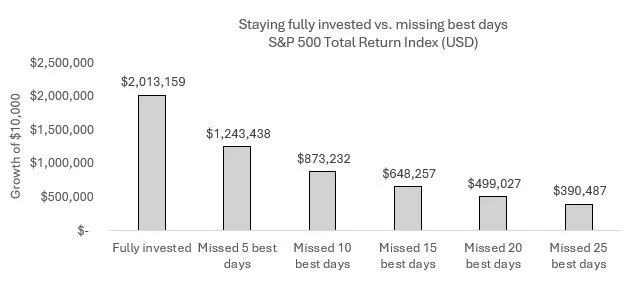
Source: Bloomberg LP. Growth of $10,000. 1980-2025.
Because we do not know when the best and worst days in the market will be, the best prescription for building long-term wealth is to stay invested for the long-term and resist the allure of market timing.
Volatility is normal
While the benefits of staying invested for the long-term are clear, the pain of drawdowns over shorter periods is real. From 1980 to 2025, the S&P 500 Index experienced average intra-year declines of 14.2% in each calendar year. Those declines were painful and scary, but it is worth noting their temporary nature. Despite drawdowns, the S&P 500 Index was positive in 35 of the 46 years over our measurement period, or 76% of the time.

Source: Bloomberg LP. Returns and drawdowns in calendar years. 1980 – 2025.
Markets do not move in straight lines. Periods of downside volatility are normal, even in strong markets and in years that finish positive.
Consider a particularly dramatic example, the COVID drawdown of 2020. The S&P 500 Index had reached a peak on February 19, 2020, but with the news of an emerging worldwide pandemic, the index dropped more than 30% by Mach 23, 2020. As dramatic as this sudden decline was, it was temporary in nature. By August 24, the index had rebounded to surpass its earlier peak and the bull market in equities had returned.
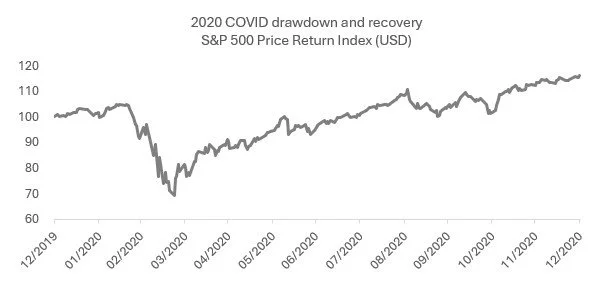
Source: Bloomberg LP. Indexed performance. Calendar year 2000.
Understandably periods of volatility can be unsettling. Investors may be tempted to sell when markets decline, often fearing further losses. However, these periods are often the worst time to exit and can represent meaningful opportunities for those willing to invest and put money to work. The biggest risk for long-term investors is often not volatility itself but reacting to short-term market declines in ways that can disrupt long-term investment growth.
What this means for investors
Market movements are unpredictable in the short term.
The strongest days often occur during periods of uncertainty.
Missing even a small number of days can meaningfully impact long-term returns.
Staying invested is one of the most effective ways to build wealth over time.
InvestEd
Successful investing is not about perfectly timing entry and exit points; it’s about time in the market, and the discipline to stay invested through uncertainty. Over the long-term, investors biggest advantage is likely to be participating in markets, not trying to predict them.
References
