The power of compounding
Compound interest is the eighth wonder of the world. He who understands it, earns it; he who doesn’t, pays it.
Attributed to Albert Einstein
Legend has it that the inventor of chess – in some stories, Sessa, an ancient Indian minister – requested his ruler pay him in rice according to the rule that a single grain of rice on the first square of a chessboard would double on each subsequent square for a total of 63 doublings.
The ruler readily accepted the proposal and initially laughed before being informed by his court treasurers of the true magnitude of what had been promised.
Enter compound growth
The total grains of rice can be shown to be 264 -1 = 18,446,744,073,709,551,615 or 18 quintillion grains of rice and would weigh over 461 billion metrics tonnes which would be a mountain of rice larger than Mount Everest.
Of course, the chessboard example assumes 100% rate of compounding, far higher than what investors experience in the real world. Yet the example still highlights an important point: growth can accelerate over time in ways that are difficult to appreciate at first.
Even some of the most successful investors in history compounded at rates far below our chessboard example. Warren Buffett (one of history’s greatest investors) has compounded capital at approximately 20% annually for decades, while the S&P 500 Index has historically returned roughly 10% annually including dividends over the long term.1
Importantly, investors don’t need extraordinary returns to benefit from compounding. Given enough time, even more modest (and realistic) long-term returns can produce meaningful results.
Math!
A central concept of investing is the time value of money which states that a sum of money is worth more today than the same amount in the future because it has the potential to grow through interest or investment. The time value of money formula is as follows:
Future value = Present value * (1 + R) ^ N, where:
Future value = what your investment will be worth in the future
Present value = Your initial investment and periodic cash flows
R (rate of return) = how much your investment grows each year on average
N (time) = the number of years your money is invested
What is the most important variable in the time value of money formula?
Is it your initial investment and periodic cash flows (present value), your rate of return (R), or the number of periods invested (N)?
An example will help us answer this question.
A more realistic example
Let’s compare two investors, Alex and Taylor.
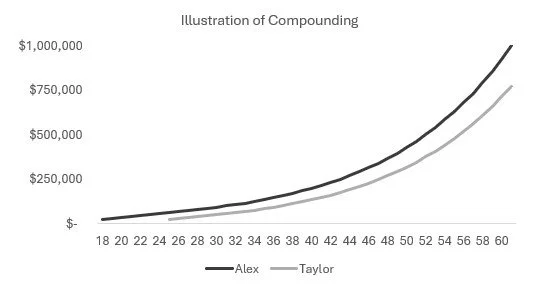
Alex starts investing at 18 with an initial investment of $25,000 and invests an additional $2,000 for the first eight years of her investing life making no subsequent investments after that. Taylor, on the other hand, holds off until 25 when he makes his initial investment of $25,000 and invests an additional $2,000 every year until he turns 60.
While Alex makes additional investments of $16,000, Taylor makes additional investments of $72,000. Who has more money at 60 years of age?
While both Alex and Taylor compound at a rate of 8% annually, Alex has an ending investment value of almost $1 million whereas Taylor has an investment value of less than $775,000.
Source: Illustrative example.
Despite making significantly less contributions - $16,000 vs. $72,000 – Alex’s early start helps her build an investment portfolio which is almost 30% larger than Taylor’s by the age of 60.
It should be clear that the most important variable in the time value of money formula is the number of periods invested (N). Time, thanks to the power of compounding, triumphs in investing!
Time is an advantage
Starting earlier allowed Alex’s investment more time to compound, and that difference more than offset the additional contributions Taylor made.
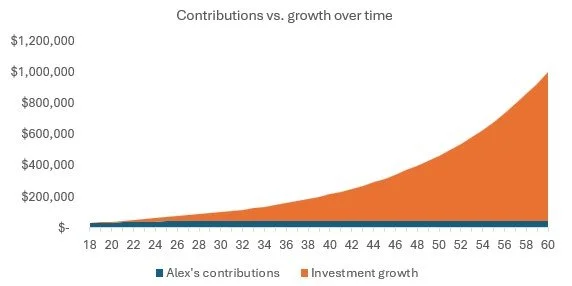
Alex’s example also highlights another important point: over time, investment growth can become a much larger driver of portfolio value than the amount originally invested. While Alex contributed a total of $41,000, most of her ending portfolio value came from growth generated through compounding.
Source: Illustrative example.
Starting early and staying invested allows investors to fully harness the power of compounding. Yet many investors delay getting started or interrupt the process. Waiting for the “right time” or selling during periods of uncertainty can reduce the effectiveness of compounding and make long-term goals harder to achieve. Compounding rewards consistency and patience, not timing.
What this means for investors
Compounding is one of the biggest advantages long-term investors have.
Starting early can have a meaningful impact on long-term investment outcomes.
Delaying or interrupting investing can make long-term goals harder to achieve.
InvestEd
Compounding is one of the most powerful forces in investing, but it requires time to work. The earlier you start, and the longer you stay invested, the more meaningful the results can be.
References
Bloomberg LP. From 12/31/1927 to 12/31/2025 the S&P 500 Total Return Index (USD) grew at an annualized rate of 9.79%.
Backup data:
